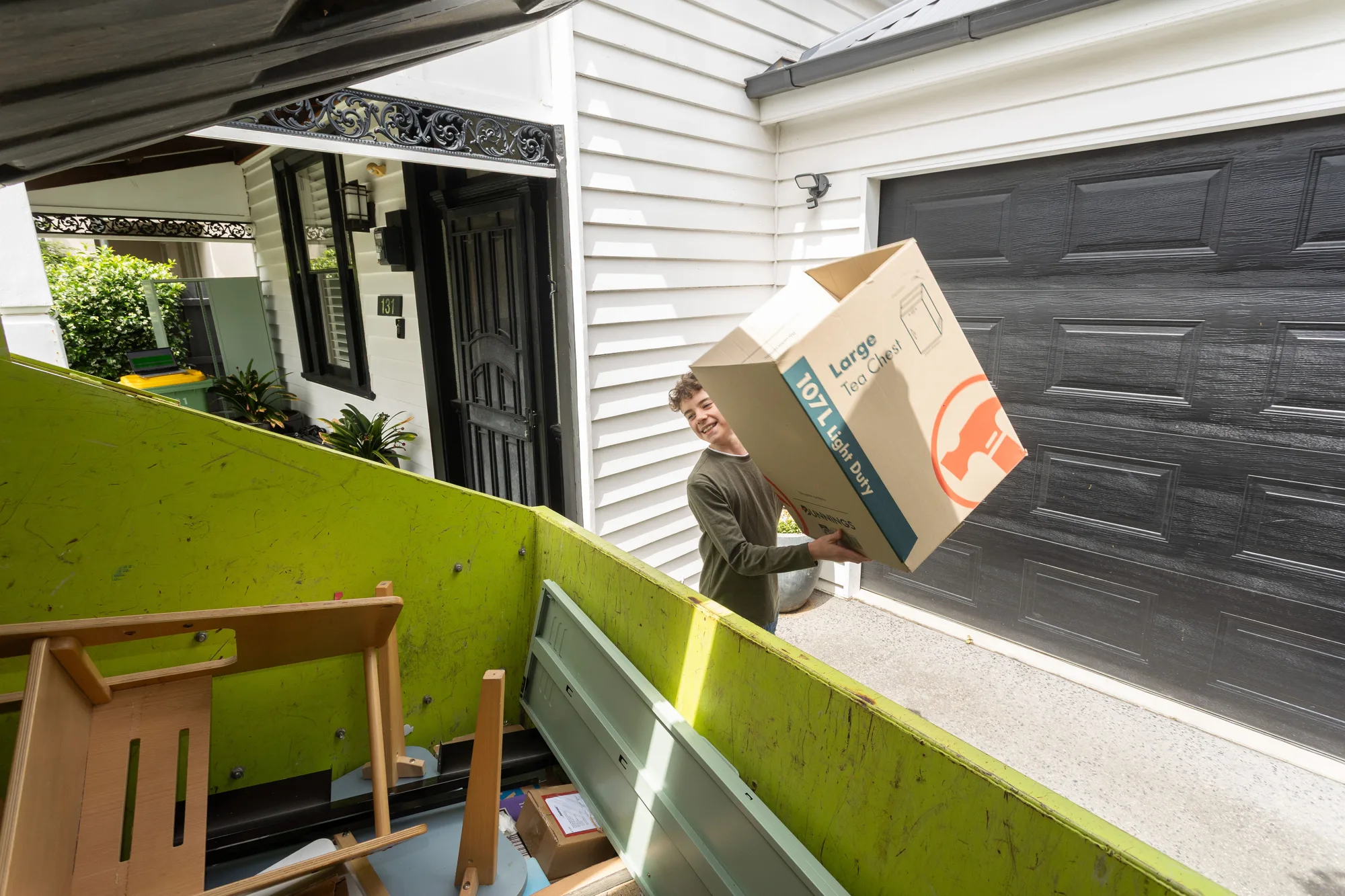
Renovations and builds make a lot of waste, and some of it is very heavy. This guide shows what you will have, which skip suits it and what has to stay out.
Key takeaways
- Building, general and green rubbish can all go in the same bin.
- Sand and soil count as heavy stuff, and so do bricks and concrete.
- All three skips are the same 4 cubic metre bin. Heavy includes 1,000 kg and Standard includes 500 kg. Half includes 300 kg.
- Heavy takes up to 5 wheelbarrows of heavy stuff. Standard takes 1 and Half takes none.
- Asbestos never goes in a skip. Paint and chemicals stay out too, and so do batteries.
- No council permit is needed when you book. Councils still set their own rules for the street and nature strip.
- A build makes waste in stages, so the bin should arrive when each stage does.
1. What waste to expect
Most renovations and builds make more than one kind of waste. It helps to sort yours into groups before you book.
Building rubbish is what comes out of a reno or a build.
- Plaster
- Timber
- Carpet
- Steel
- Other building rubbish
Heavy stuff is the dense material that adds weight fast.
- Sand
- Soil
- Bricks
- Concrete
- Gravel
General and green rubbish turns up on most jobs too.
- Furniture
- Boxes
- Electrical goods. Take the batteries out first. No fridges.
- Gardening waste
- Trees
- Branches
You do not need a separate bin for each group. A mixed waste skip takes general, building and green rubbish together in one bin. Heavy stuff goes in too, within your skip's limit.
2. Heavy stuff weighs more than it looks
A small amount of heavy stuff weighs more than it looks. Soil often reaches the weight limit before the skip looks full.
How much heavy stuff you can load depends on your skip.
- Heavy: up to 5 wheelbarrows of heavy stuff.
- Standard: up to 1 wheelbarrow of heavy stuff.
- Half: none.
If your job is mostly heavy stuff, book a Heavy skip. Read more in What is Heavy Waste.
Asbestos never goes in a skip. It is worth finding out about old slabs and render before you load them.
The concrete and brick, heavy waste and soil and dirt pages cover each type in more detail.
3. Choosing your skip
Every Mobile Skips bin is the same 4 cubic metres. The Heavy, Standard and Half skips are all that same bin. Only the weight allowance changes.
- Heavy skip: 1,000 kg included. It takes up to 5 wheelbarrows of heavy stuff.
- Standard skip: 500 kg included. It takes up to 1 wheelbarrow of heavy stuff and suits a mixed job.
- Half skip: 300 kg included. It fills the bin to the halfway mark and takes no heavy stuff.
For a renovation, most jobs land on the Heavy skip. A lighter weekend job such as one room suits the Standard skip.
For construction and building, book the Heavy skip for the structural stages. The Standard skip suits the lighter fit-out and tidy-up.
Choose for the heaviest thing you are loading. You can find all three skips on the skip bin hire page.
4. If you go over the weight allowance
Going over your allowance means extra charges.
- Half: your booking is upgraded to the Standard skip.
- Standard: your booking is upgraded to the Heavy skip.
- Heavy: you pay a per-kilo charge for every kilo over 1,000 kg. There is no bigger bin to move up to.
A Mobile Skips bin cannot be loaded past 1,200 kg in total. The lid must be able to close.
5. Match the bin to the stage of the job
A build makes waste in stages, so the bin has to arrive when the stage does. On a renovation, pick the day your tradies start.
When you book, you choose the delivery day and time slot that fits your programme. Delivery can be the same day, within 3 hours of booking.
Your skip is delivered within the window you booked, or it's free.
The average hire is 2 days, or 3 over a weekend. You can extend if plans change. There is no extra cost if weather delays your job.
Trade accounts are available for builders and site supervisors.
6. Where the skip goes
The Mobile Skips bin is compact and fits where a car can park. A driveway is all it needs. Car parks and apartment developments are fine too.
Every skip sits on a road-safe and tow-able trailer. That is why no council permit is needed when you book.
Councils still set their own rules for the street and nature strip. It is worth a quick check with your council.
You can move the skip around your property as the job moves. A lockable lid keeps everything inside between loads.
7. What stays out
- Asbestos. It never goes in a skip.
- Chemicals
- Poisons
- Batteries. Take them out of electrical goods first.
- Paint
- Food waste
- Biological waste
- Gas bottles
- Fridges. They need separate processing.
Soil that has had fuel or oil spilled on it stays out too.
Mattresses and tyres can go in. They cost extra.
If something on the list turns up in the bin, we can't collect until it's sorted. The full list is in What Can and Can't Go in a Skip.
8. What happens to your waste
Your waste goes to our tipping partners. They dispose of it through a mix of recycling and registered landfills.
9. When you are ready to book
Enter your postcode when you book online and your fixed price for your area shows straight away. If the skip does not suit your job and it is empty, you can cancel free of charge.
Pick your skip and choose your day. We're ready when the work is.